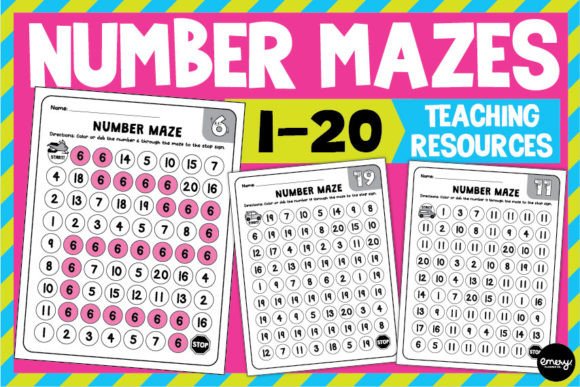
Number Mazes 1-20: Dot the Number Mazes for Creative Learning
In the realm of educational design, the most effective tools are those that seamlessly blend pedagogical function with visual appeal. Number Mazes 1-20 | Dot the Number Mazes exemplifies this balance, offering a resource that transforms fundamental number recognition into an engaging visual journey. For designers and educators alike, this collection represents more than a simple worksheet—it’s a study in how clear visual pathways and focused interaction can enhance learning outcomes and user experience.
Visual Design Principles at Play
Each maze in this set is a masterclass in visual hierarchy and user flow. The design guides the young learner’s eye from a clear starting point to a defined endpoint (the stop sign), using the focus number as a recurring visual motif. This mirrors principles used in UI/UX design, where intuitive pathways reduce cognitive load and improve task completion. The black-and-white format is a strategic choice; it eliminates color distraction, emphasizes line work and shape recognition, and offers unparalleled flexibility. Users can apply their own color palette using crayons, markers, or digital tools, turning each page into a customizable creative project.
Practical Applications Beyond the Classroom
While designed for kindergarten number recognition, the underlying structure of these mazes offers valuable insights for various creative projects. Consider how the principles can be adapted:
- Brand Identity & Logo Design: The simplicity and clarity of the maze paths can inspire logos or brand marks that convey guidance, progression, and problem-solving.
- Marketing & Social Media Graphics: The dot-the-number mechanic can be reimagined as an interactive element in digital ads or social media stories, encouraging user engagement through simple, playful actions.
- Editorial & Web Design: The clean, uncluttered layout serves as a template for designing infographics, navigation menus, or interactive web elements that require clear directional flow.
- Packaging & Merchandise: The maze motif can be adapted into engaging patterns for children’s product packaging or educational merchandise, adding a layer of interactive play.
Integrating Assets into Your Design Workflow
For designers seeking to incorporate such assets, evaluation should focus on consistency, scalability, and compatibility. This product’s high-resolution 300 dpi files ensure crisp output for both print design and digital use. The included PDF and JPEG formats provide flexibility for various software environments, from Adobe Creative Suite to Canva. When using these elements, consider how they align with your project’s existing typography and visual language. The neutral black-and-white foundation makes them exceptionally adaptable; they can be tinted, overlaid, or integrated into more complex compositions without clashing.
Ultimately, resources like Number Mazes 1-20 | Dot the Number Mazes underscore a vital design truth: effective communication often lies in thoughtful simplicity. By prioritizing clear structure, intuitive interaction, and adaptable aesthetics, designers can create materials that are not only visually polished but also functionally superior. Whether you’re developing educational content, crafting engaging marketing materials, or exploring new visual systems, investing in well-considered design assets elevates both the aesthetic quality and the communicative power of your work.